Red Eye in Clinical Practice: When You MUST Consult an Ophthalmologist
On this page
Introduction
Red eye is one of the most common presentations in outpatient and emergency settings. Most cases are benign (e.g., conjunctivitis), but missing a vision-threatening condition can lead to permanent blindness.
As a new doctor, your job is not to diagnose everything — your job is to recognize danger early and refer appropriately.
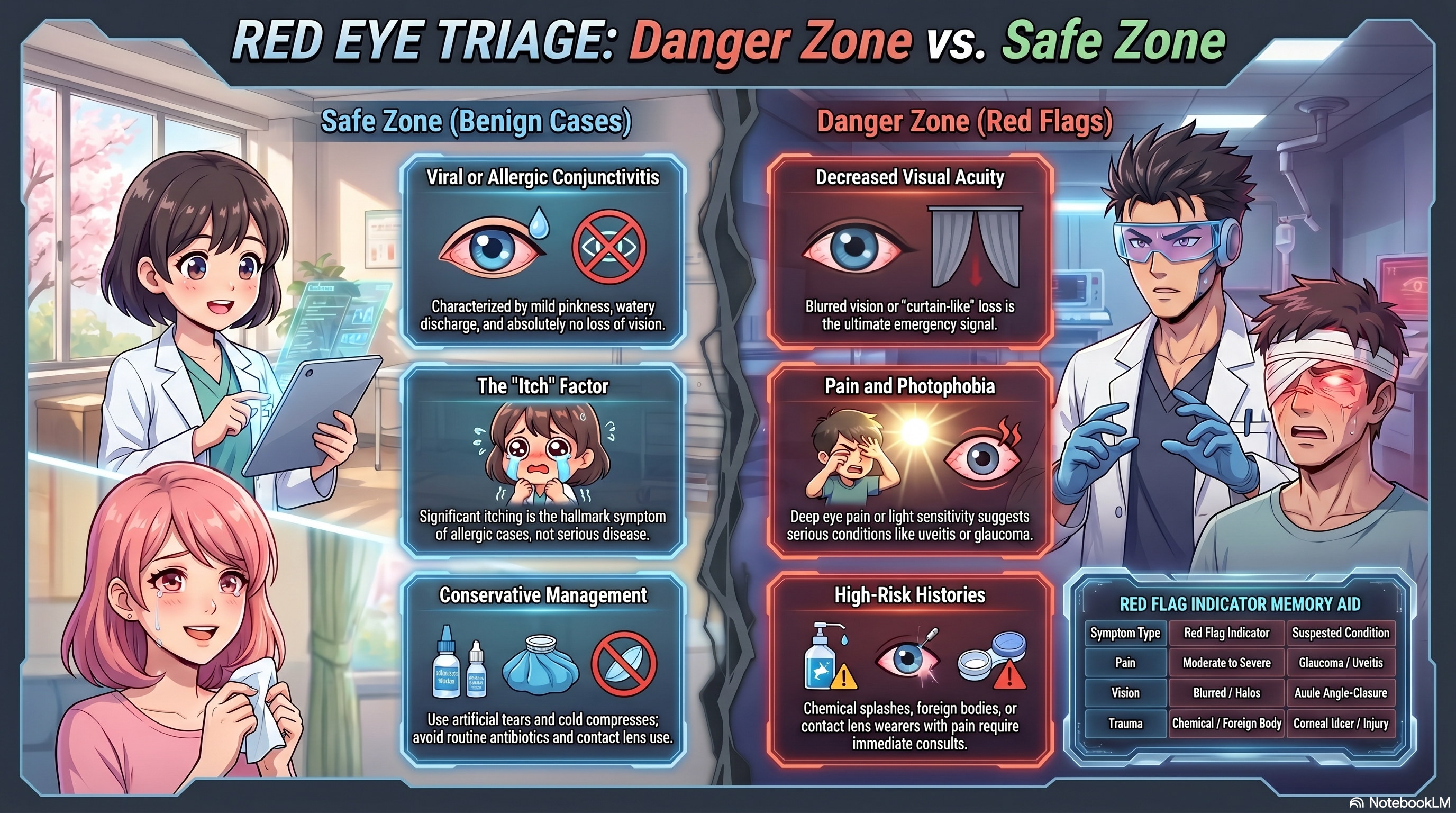
🧠 Step 1: Think Simple First
Ask yourself:
👉 “Is this just conjunctivitis, or could this destroy vision?”
Most benign cases:
- Mild pink/red eye
- Watery discharge
- No significant pain
- No visual loss
👉 These are usually viral or allergic conjunctivitis
⚠️ Step 2: RED FLAGS = CONSULT NOW
If ANY of the following are present →👉 Immediate ophthalmology consult (same day / emergency)
🔴 Vision-related
- Blurred vision (true visual acuity reduction)
- Patient says: “I cannot see clearly like before”
🔴 Pain-related
- Moderate to severe eye pain
- Not just irritation or itch
🔴 Light sensitivity
- Photophobia→ Think uveitis / keratitis
🔴 Dangerous associated symptoms
- Headache + nausea + vomiting→ Think acute angle-closure glaucoma
- Seeing halos / rainbow around lights
🔴 Trauma / Exposure
- Chemical splash
- Foreign body
- Eye injury
🔴 Contact lens wearer
- Red eye + pain→ High risk for corneal ulcer (EMERGENCY)
🔴 Cornea abnormal
- Corneal opacity
- Suspected ulcer
🔴 Retinal warning signs
- Flashes
- Floaters
- Curtain-like vision loss→ Retinal detachment
⚡ Golden Rule for New Doctors
👉 “Red eye + decreased vision = NOT conjunctivitis until proven otherwise.”
🟢 Step 3: Likely Benign Cases (NO Red Flags)
These can be managed conservatively:
✅ Allergic conjunctivitis
- Itchy (key symptom)
- Watery discharge
- Mild redness
- Eyelid swelling
✅ Viral conjunctivitis
- Watery eye
- Mild irritation
- Starts unilateral → bilateral
🩺 Basic Management (Non-emergency)
- Artificial tears
- Cold compress
- Avoid rubbing eyes
- Stop contact lenses
- Hygiene (prevent spread in viral)
❌ No routine antibiotics unless bacterial infection suspected
🎯 Clinical Pearl (High-Yield Exam Point)
Watery eye ≠ mild disease alwaysBUTBlurred vision = RED FLAG ALWAYS
🧪 What You MUST Always Check
Even in busy OPD:
- ✅ Visual acuity (VERY IMPORTANT)
- ✅ Pain level
- ✅ Photophobia
- ✅ Contact lens history
📌 Real-Life Decision Example
Case:
- Pink eye
- Watery
- Mild swelling
- No pain
- Vision normal
👉 Manage as conjunctivitis → NO urgent consult
Case:
- Red eye
- Watery
- “Vision slightly blurred.”
👉 ❗ STOP👉 This is NOT simple conjunctivitis👉 Consult ophthalmology
🧠 Final Takeaway
You don’t need to be an ophthalmologist.
But you MUST know:
👉 Who is safe👉 Who is dangerous
🚨 One-Line Memory Trick
“PAIN + PHOTOPHOBIA + POOR VISION = REFER IMMEDIATELY”