


Translating Regression-Type Machine Learning into the Language of Clinical Research
Machine learning isn’t a new species of science — it’s an evolution of the statistical logic that epidemiologists already use. We’ve always modeled the relationship between exposure and outcome, adjusting for confounders and exploring patterns. What ML brings is automation, scalability, and the ability to capture complex, nonlinear, interactive relationships that traditional regression often misses. 1️⃣ Level 1 — Traditional Regression: The Clinical Baseline Before diving int
Scikit-Learn Algorithm Cheat Sheet — Clinical Epidemiology Edition: Choosing the Right ML Type
🟡 START You begin by asking: What kind of problem am I trying to solve in my study? Common scenarios in clinical epidemiology : Identifying patients with a disease → diagnosis Predicting future outcomes → prognosis Estimating biomarkers or lab values → continuous prediction Finding hidden patient subgroups → phenotyping Simplifying many variables into a few patterns → data reduction 🔹 1. Do you have labeled data? YES → Go to Supervised Learning (you know the outcome) e.g.
Hyperthyroidism: Definition, Causes, Diagnosis & Stepwise Management Guide [MMI, PTU]
1️⃣. Definition and Pathophysiology Hyperthyroidism = overproduction of thyroid hormones ( T3, T4 ) by the thyroid gland → suppressed TSH . Thyrotoxicosis = clinical syndrome of excess circulating thyroid hormone, regardless of cause (e.g., Graves, thyroiditis, toxic nodular goiter). Pathophysiology summary: ↑ T3/T4 → ↑ basal metabolic rate ↑ β-adrenergic receptor sensitivity → palpitations, tremor Feedback inhibition → ↓ TSH from pituitary 2️⃣. Common Causes Category Disea
How to Adjust Methimazole (MMI) Dose in Hyperthyroidism: A Step-by-Step Lab-Based Guide
🎯 1. Goal of Therapy Normalize Free T4 (FT4) and Free T3 (FT3) levels. TSH is not reliable early — it remains suppressed for weeks to months even after hormones normalize. The primary lab for dose adjustment = FT4 (± FT3) . 🧪 2. Monitoring Schedule Time after starting MMI Lab to Check Why Baseline TSH, FT4, FT3, CBC, LFT Starting point & safety 4–6 weeks after starting FT4 ± FT3 (ignore TSH) Adjust dose Every 4–6 weeks thereafter FT4 ± FT3 Continue titration Once euthyr
N in Research: More Than a Number — A Measure of Believability, Meaning, and Chance
“N in research represents the p-value — it reflects how believable a result is, or whether the difference is simply due to random change.” In clinical research, we often treat N , the sample size, as a mechanical requirement — something to “get enough patients” or “reach significance.”But that view is incomplete. N is not just a number; it is a claim about credibility. It defines how convincingly we can argue that a difference is real , not random . It connects p-values , cl
Validating a Multi-Step Deduplication Strategy in Systematic Reviews
Introduction Removing duplicate citations is a vital step in systematic reviews. Duplicate records not only inflate the screening workload but also introduce potential bias if counted more than once in the analysis. Effective deduplication ensures that each unique study is represented only once, maintaining both accuracy and efficiency in the review process. One widely validated and reproducible approach is the multi-step deduplication strategy in EndNote, often referred t
From Regression to Neural Networks: A Conceptual Bridge for Clinical Researchers
Abstract Logistic regression and neural networks share a deep mathematical and conceptual structure. Both compute weighted sums of...
Prediction vs Causation in Clinical Research: Using the DEPTh Model to Choose the Right Approach, Causal vs Non‑Causal—How to Choose the Right Study Logic
Clinicians often juggle questions that look similar but actually demand different scientific logics. The DEPTh model (Diagnosis,...
The “10 Events-per-Variable” 10 EPV Rule in Clinical Prediction Modeling
For many years, the 10 Events-per-Variable (EPV) rule was the default checkpoint for building clinical prediction models. The idea is...
The Fontan Procedure and Its Hepatic Complications: Understanding Fontan-Associated Liver Disease (FALD)
1️⃣ What Is the Fontan Procedure? The Fontan procedure is a palliative cardiac surgery performed for children with single-ventricle congenital heart defects , where only one ventricle is capable of supporting systemic circulation. ➤ Purpose: To separate systemic and pulmonary circulation in patients who cannot undergo a biventricular repair. ➤ Indications: Common congenital heart diseases requiring Fontan include: Tricuspid atresia Hypoplastic left heart syndrome (HLHS) Do
Orchitis Overview: Viral vs Bacterial Causes, Diagnosis, and Treatment Strategies
🔹 Definition Orchitis is an inflammation of the testicular parenchyma .It can occur as: Primary orchitis (rare, often...
Epididymitis Explained: Diagnosis, Causes, and Treatment by Age and Risk Factors
🔹 Definition Epididymitis is the inflammation of the epididymis , the coiled duct located posterior to the testis responsible for sperm...
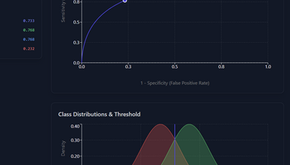
ROC Curve & AUC Explained: Interpretation, Application, and Clinical Relevance
Introduction The Receiver Operating Characteristic (ROC) curve is a cornerstone metric in both diagnostic and prognostic model...
Insect Bite of Unknown Type: Diagnosis, Treatment, and Red Flag Monitoring (Bee, Wasp, Hornet, Ant, Mosquito, Flea, Bedbug, Rove beetle, Centipede, Spider, Tick, Mite, Louse, Scorpion)
🟢 Hydrocortisone 1% + Antihistamine = first-line treatment 🟡 Add antibiotics ONLY if infection (cellulitis, pus) 🔴 Epinephrine IM = first-line for anaphylaxis 💊 Treatment Summary Table Category Drug Dose & Route Frequency Duration Notes Topical steroid (first-line) Hydrocortisone 1% cream Apply thin layer bid 5–7 days ✅ Safe, exam-preferred Topical steroid (severe inflammation) Betamethasone 0.1% cream Thin layer bid ≤5 days Short course only Antihistamine (oral) Loratadi
Antifungal Regimens for Onychomycosis: Drug Choices, Dosing, and Practical Pearls (Fungi, Fungus)
Antifungal Regimens for Onychomycosis Drug Fingernails Toenails Notes Terbinafine 250 mg PO once daily × 6 weeks 250 mg PO once daily × 12 weeks First-line for dermatophytes. Check baseline LFTs. Itraconazole (continuous) 200 mg PO once daily × 6 weeks OR 100 mg PO BID × 6 weeks ( off-label ) 200 mg PO once daily × 12 weeks OR 100 mg PO BID × 12 weeks Effective but higher drug–drug interactions. Itraconazole (pulse) 200 mg PO BID × 1 week per month , repeat × 2 months 200 mg
Types of Research Reviews: Literature Reviews, Systematic Reviews, and Scoping Reviews Explained
Literature Review – No strict system; risk of bias – It is informal, narrative, and selective – Purpose: to show what’s known, critique,...
Tinea Infections: Diagnosis, Lesion Patterns & Treatment by Site
Diagnosis (Lesion Characteristics) 🟢 Tinea corporis (ringworm of body) Annular (“ring-shaped”) lesion with erythematous, scaly, raised...
Internal Hemorrhoid Grading & Management by Goligher's Classification (Daflon, Diosmin, Docusate, and Rubber band ligation)
1. Grading (Goligher’s Classification) Grade I : Bleeding, no prolapse. Grade II : Prolapse with defecation, reduces spontaneously. Grade...
Management of Thrombosed External Hemorrhoids: When to Excise vs. Medicate (Daflon, Diosmin, Docusate, and Sitz bath)
✅ Setting OPD (Outpatient) if lesion is small, pain tolerable, no complications. IPD (Inpatient) only if severe pain, large thrombosis,...
The Master Chef Behind AI: Fine-Tuning (LoRA), Knowledge Files aka. Retrieval-Augmented Generation (RAG), and Chat Memory Explained
Introduction Have you ever chatted with an AI and wondered how it works? One moment it's adopting a new personality, the next it's...
Zoon’s Balanitis: Diagnosis and Management. Well-defined, shiny, reddish-orange patch at the glans penis.
🔎 Introduction Zoon’s balanitis , also known as plasma cell balanitis , is a chronic, benign inflammatory condition of the glans penis,...
Bramer Method for Deduplication in EndNote: A Validated Multi-Step Workflow
Introduction: Why Deduplication Matters Systematic reviews live or die by rigor—and that starts with your reference list. If duplicate...
GLM Families and Effect Measures: Choosing the Right Model for Y
GLM Family Y: Data Type Link Function / Model Effect Measure Gaussian Continuous (e.g., BP, cholesterol) Linear regression Mean...